
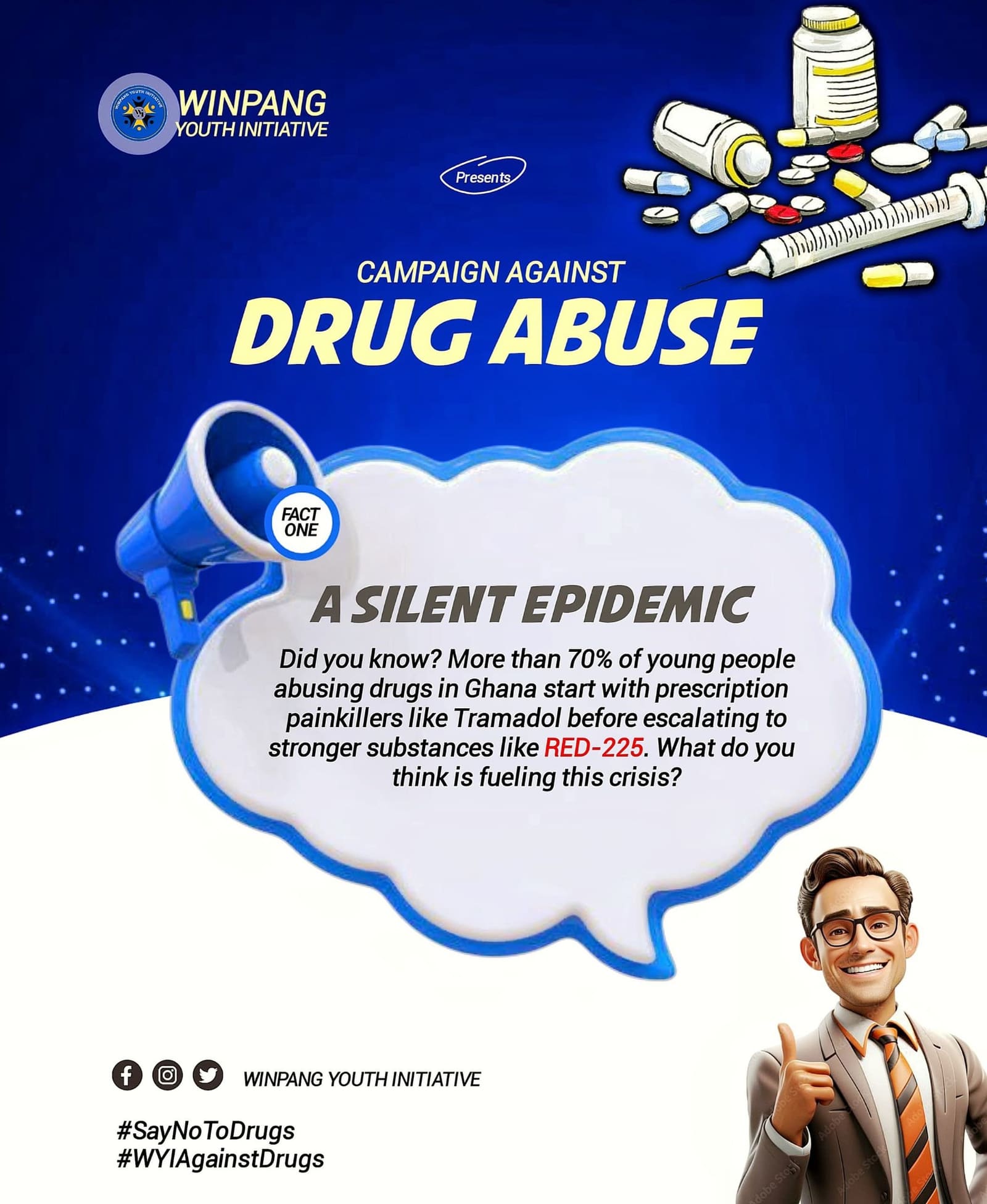
Understanding the Silent Epidemic
Drug abuse among young people in Ghana is a growing crisis, often beginning with the misuse of prescription painkillers like Tramadol. Termed a "silent epidemic," this issue has become an alarming trend. According to a 2023 report by the United Nations Office on Drugs and Crime (UNODC), over 70% of young drug abusers in West Africa, including Ghana, initially start with prescription opioids before progressing to stronger substances. This finding aligns with a recent Winpang Youth Initiative poll, where 37 out of 48 respondents identified Tramadol as the most commonly abused drug among Ghanaian youth, highlighting its role as an entry point to drug addiction.
What are Tramadol and RED-225?
Tramadol is an opioid painkiller prescribed for moderate to severe pain, with standard doses ranging from 50 to 100 mg. However, in Ghana, misuse of higher doses, such as RED-225 (225 mg), is widespread. Known as "Red 225" due to its packaging, this formulation delivers a more intense euphoric effect, making it highly sought after on the black market. Despite the Ghana Food and Drugs Authority (FDA) classifying Tramadol as a controlled substance, it remains readily available through unregulated channels, fueling its abuse.
Why Do Young People Start with Prescription Painkillers?
Several factors contribute to the misuse of prescription painkillers among young Ghanaians:
• Ease of Access: Tramadol is easier to obtain than illicit drugs like cocaine or heroin. It is sold in markets, on the streets, and through unlicensed pharmacies, often without a prescription. A 2021 study by the West African Commission on Drugs (WACD) found that Tramadol is among the most trafficked pharmaceutical drugs in the region.
• Perceived Safety: Many young people mistakenly believe that prescription drugs are safer than "street drugs" because they are medically approved. This misconception lowers the perceived risk, leading to experimentation.
• Social and Peer Pressure: Peer influence plays a significant role in drug initiation. Young people often try Tramadol due to encouragement from friends who use it to "feel good," stay awake, or enhance performance. A 2022 study in the Journal of Substance Abuse Treatment identified peer pressure as a leading cause of opioid misuse among West African adolescents.
• Mental Health and Stress: Unemployment, academic pressure, and poverty push many youths towards Tramadol’s euphoric effects as a temporary escape. The Ghana Mental Health Authority reported in 2023 that youth mental health issues are rising, often correlating with substance abuse.
• Lack of Awareness and Education: Many young people are unaware of the dangers of prescription drug abuse. Without proper education, they fail to recognize Tramadol’s potential to lead to addiction, overdose, and progression to harder drugs.
The Progression to Stronger Substances
The journey from Tramadol to stronger substances like RED-225, cocaine, or heroin is a dangerous escalation:
• Tolerance and Dependence: Regular Tramadol use leads to tolerance, where users need higher doses for the same effect. This often results in seeking stronger formulations like RED-225, increasing the risk of overdose. According to the UNODC, non-medical Tramadol use in West Africa has contributed to a 30% rise in opioid-related overdoses between 2018 and 2023.
• Gateway Effect: As tolerance builds, users may experiment with stronger substances. The International Journal of Drug Policy (2022) found that 60-80% of opioid abusers in West Africa transition to illicit drugs within two years.
• Health Consequences: The use of stronger drugs heightens the risk of respiratory failure, seizures, liver damage, and death. The Ghana Health Service reported a 25% increase in opioid-related hospital admissions among youth over the past five years, with Tramadol being a major contributor.
What is Fueling This Crisis?
The crisis of prescription painkiller abuse among Ghanaian youth is driven by multiple factors:
• Weak Regulation and Enforcement: Despite efforts by the Ghana FDA to control Tramadol distribution, weak enforcement allows widespread trafficking. The UNODC estimates that over 100 million Tramadol tablets enter West Africa illegally each year, with Ghana as a major hub.
• Economic Challenges: Poverty and unemployment push many young people to use Tramadol as a coping mechanism or to enhance productivity in labor-intensive jobs, such as farming or fishing. This practice, known as "energy boosting," is widespread.
• Cultural Normalization: In some communities, Tramadol use has become normalized, especially among young men. Social media further exacerbates the problem by glamorizing drug use through music, videos, and influencer culture.
• Limited Access to Education and Support: Comprehensive drug education programs are scarce in Ghanaian schools and communities, leaving young people vulnerable to misinformation. Additionally, mental health support and rehabilitation services remain inaccessible to most, with only 1% of the population having access, according to the World Health Organization (WHO, 2023).
Call to Action
The Winpang Youth Initiative urges young people to recognize the dangers of prescription painkiller abuse. What may seem like a harmless experiment can quickly spiral into a life-threatening addiction. We encourage you to:
• Avoid using prescription drugs without a doctor’s supervision.
• Educate your peers about the risks of Tramadol and its potential to lead to stronger substances like RED-225.
• Share your stories and experiences with drug abuse using the hashtag #WinpangYouthInitiativeAgainstDrugAbuse to raise awareness.
• Seek help if you or someone you know is struggling with drug abuse—reach out to local health centers or organizations like the Narcotics Control Commission (NACOC) in Ghana for support.